Does Science Ever Define the Concept of “Facts”?
Please know, I find this question incredibly intuitive. Few people would think to ask it. As for the question, despite what others have written here, the short answer is definitely not. Indeed, it’s not only the word “fact” that science defines poorly. As currently practiced, science has no formal way to scientifically define any of its terms.
No surprise then, neither does science, as it’s currently practiced, have a scientific way to define its method. When asked to define this method, all people do is roughly describe how science is currently practiced. Either this or they point to the many things science has contributed to our world (which it has), as if these things justify allowing this method to remain more black art than science.
Know I love science. And most scientists are extremely hard working people. But I’m certainly not the first, or only, person to point to these flaws. Google the book, “Genesis and Development of a Scientific Fact.” This obscure book was the first to point out that scientific facts are more what people agree on than what dictionaries imply they are: unchanging ideas and measurable data.
Rather than merely find fault with science though, I spent thirty years discovering, then publishing a new scientific method. I mention this as this new method uses a cross between geometry and logic to define all of its terms. These definitions are quite different, in that they scientifically define both what something is and what something is not. No loopholes. No ad hoc words. Precisely measurable, both in and out of the lab.
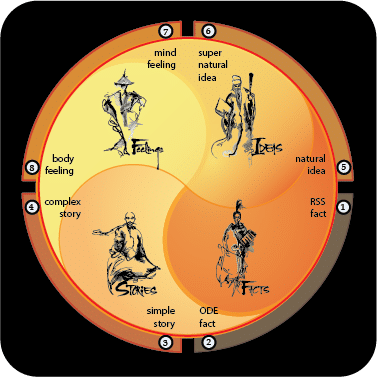
Now notice the drawing I’ve placed below. It’s the logically geometric map which I’ve used to define the word, “facts” (visible unchange). Anything which is visible and unchanging is a fact.
Now notice, this same map also defines the words “ideas/concepts” (invisible unchange), “experiments” (visible change), and “intuitions” (invisible change). Look closely and you’ll see that together, these four words account for all possible natural things. Nothing is left out.
Logically and semantically, nothing is ad hoc either. Yet together, these four definitions account for everything in our world. Know this same map also defines the four possible kinds of science: Material Science (facts are this science’s truth), Empirical Science (experiments / scientific stories are this science’s truth), Rational Science (ideas are this science’s truth), and Intuitive Science (intuition is this science’s truth).
Admittedly, it would take some effort and time to fully digest, let alone trust, that any of this is real. But for tonight, I hope you’ll find this little map at least intuitively interesting.
One more thing.
You might also find it interesting to try one of these definitions on for size, certainly the one which your question refers to: the word “fact” (visible unchange). According to this logically geometric map, anything that is visible and unchanging is a fact. The results of a horse race. The number on a scale. Where you are in this exact moment. Your calendar age.
If you refer to the outcomes arrived at in the exact places and times those measurements were made, each result is a scientific fact. And given you refer only to those particular measurements, then these facts are visible and unchanging. At those times and places, those were the results.