Do you also agree that some questions that start with ‘why’ have no practical use in daily life, and people only tend to ask them out of mental curiosity?
“The eye goes blind when it only wants to see why.”
Rumi (Coleman Barks translation)
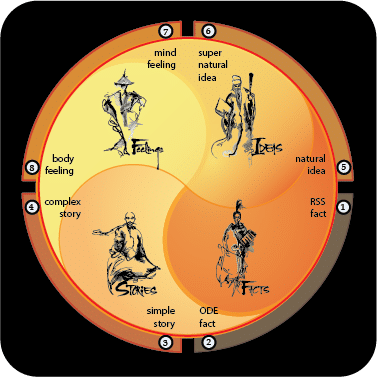
An early discovery in my work on personality (2003) was the realization that we humans have but two ways we can sense time. Before age seven, we can only experience scene-at-a time based time. Only at about age seven do we finally learn to tell watch, clock, and calendar time. At which point, we have two ways we can sense time; the kind we experience when we fall in love, where the present moment is the only moment that will ever be—and the kind we experience when we grow in love, a process which can only occur if we [1] learn from the past, then [2] change in the present, then, if we’re observant, we [3] see the improvements we’ve made in our futures.
Before-Age-Seven time has no before and no after. It only has a single “during.” For obvious reasons, it is the source of our belief in soulmates. Whereas After-Age-Seven time exists on a timeline. Therefore it has a before, a during, and an after. It is the realm of all hope, as well as all hopelessness.
Why mention this here, in response to a question about the word “why?” Because without knowing about this difference, any answers are more opinion than fact. And yes, I’ve likely pissed off a lot of people by saying what I’ve just said. But before explaining why I’m saying this, here’s an example of how being in Before-Age-Seven time affects how we experience the word “why.”
Picture yourself in a bedroom with a young mother and her four year old son. He’s having a play date wherein two other four year olds are also there. You and this mother have just heard something going wrong. So you hurry to his room. And when you arrive, one of the visitors is crying and tells you both, ”He hit me.”
Here, the “he” refers to her son. So at this point, the young mother, like all normal human mothers, sternly asks her son, “Why did you hit him?” The way adults normally use the word “why,” they’re asking for a logical explanation. Never once has someone told me why, let alone referred to how badly, this request harms children. Yet this seemingly innocuous act, done forcefully enough, will permanently undermine this child’s self worth. From then on, he or she will, for no obvious reason, feel anxious when questioned as to what is true.
What is happening here? Well think about it. Can a four year old understand logic? No. Because in order to know logic, you must understand After-Age-Seven time. Logic requires we do something like, “this, then this, therefore this.” This means logic only exists when you can experience a timeline, and our sense that timelines exist only begins around age seven.
Before that, none of us understands how scenes exist on a timeline. We understand time only as the present, or the “presently being recalled,” moment. So where, before age seven, do children find their answers? Since they’re under extreme pressure, they do what anyone would do. They can’t understand logic. So they fabricate their answers. And this quickly becomes habit, as children learn mommy reacts better to bullshit answers than she does when you have no answers at all.
Can you see it yet? The word “why” has two meanings—the first “Before-Age-Seven time” meaning, and the second, “After-Age-Seven time” meaning. After age seven, these two meanings remain in place for the rest of our lives. They then show up in most of the events of our lives in invisible, often detrimental ways.
For instance, take what happens in most talk therapy sessions. All therapists employ the two “whys” without ever realizing the word “why” means two different things. Questions based on the first “why,” the Before Age Seven why, are requests for the person to describe “what happened.” “What happened” is a request for the person to describe the detective’s details;’ “Just the facts, Ma-am.”
Questions based on the second “why,” the After Age Seven why, are requests for “logical explanations” as to why this event happened, why it unfolded as it did. This is the source of all beliefs that claim “everything happens for reasons.” Unfortunately, most times, the reasons we offer are the “don’t risk displeasing mommy” answers, the stuff we fabricate after the fact, rather than that the person’s nature determines the behavior.
A more general way to see this difference is to substitute the word why with the word “what.” What do I see happening right now in this scene? This “why” is a request to know the nature of a thing—how it looks and behaves. It is not a request for a logical explanation as to why this thing exists and behaves this way. Rather, it’s a request to know who and what this thing is, nothing more.
OTOH, the second “why” IS a request for that logical explanation. To me, this is what Rumi was referring to in that quote. The arrogant assumptions some human beings make as to being able to understand why nature is the way it is. Here, by nature, I’m referring to both human nature and the nature of our world.
A closing thought on people seeing this distinction.
As I’ve said ad nauseam, few people recognize the significance of this facet of human nature. I know this personally. I’ve searched for references to it for decades now. The one that I did find which stands out? Just this. That the Pope, early in the Twentieth century, declared age seven to be the “age of reason.” Thus he reasoned that children, at age seven, could now understand logic. He then interpreted this to mean that children age seven or older were now responsible for their sins.
When we demand that young children explain their behaviors before they can understand logic, we are the ones who are sinning. Grievously, in fact.