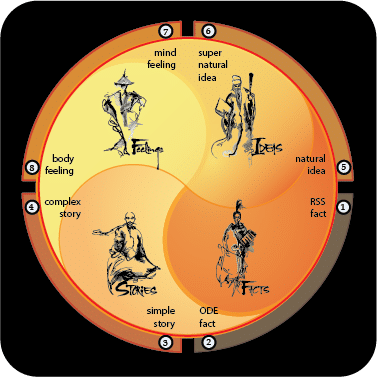
Can a statistical model ever represent the subjective experience of a human mind?
Can a turd ever taste like ice cream?
I would venture a guess that anyone seriously asking this question took statistics in college, but missed the first class.
Consider what the person who originally introduced statistics to the world, Swiss mathematician, Jacob Bernoulli, had to say about applying probability (including statistics) to individual cases. Early on in his foundational treatise, Ars Conjectandi (The Art of Conjecture), published posthumously in 1713, he foreshadows the key warning expressed in all first classes in modern statistics by saying (and I’m paraphrasing), “Never mistake statistics for an actual truth. It can be helpful when the actual truth cannot be known.”
Ironically, most students, and most professors, never mention this again, and this caution gets immediately dismissed and quickly forgotten. In truth, statistics then gets treated as an actual truth, rather than an occasionally useful tool for averaging descriptions of the qualities of large groups.
No descriptions of an individual human being can be derived from any normal mathematics, regardless of its otherwise excellent uses. Why not? There are several reasons, all of which get overlooked.
One. because “personality,” a complex description of what makes an individual person this person, is not knowable from observations of said person’s behaviors. Personality is what precedes behavior. Behavior is a response to the person reacting to life through the lens of his or her personality. In other words, personality functions like a filter, in that it results in us being unable to fully become aware of life. Hence our often odd, and illogical, responses to life.
Two. Because personality, like descriptions of any living thing, can only be described using a nested structure consisting of “natural (fractal) patterns.” No coincidence, the two models most used to refer to personality are an onion and Russian nesting dolls.
Three. Despite these ideas being obvious to anyone who looks for them, the world has insisted on using linear measures to access individual persons. This includes patently stupid personality theorists who advocate for some variation of the statistically based “Five Factor” model. What am I saying?
Well think about it. We’re approaching 9 billion people on our planet. Can we derive enough from this egregiously vague set of five statistically based qualities to know which person, or even which small group of persons, we are referring to? In truth, the only way to achieve anything close to this is to use fractal-based measures.
Does such a system exist?
Yes. And please forgive this mention. As of this week, I’ve published my sixth book describing various aspects of this topic. Arguably, this is my most ambitious (and perhaps, insane) attempt at describing an aspect of the human mind and personality.
The book?
The Science of Love – an unusual look at life’s greatest mystery.
All this is to say, no, statistics cannot, and forever will be unable to, describe the personality and mind of any individual human being, whereas Natural (fractal; non-linear) Patterns can do a pretty good job.
P.S. Years ago, I sent copies of my second book, Unraveling Human Nature, to some one hundred personality theorists. All but one ignored my doing this. Crickets all the way. However that one man responded with great kindness and honesty. He, one of the founders of the “Five Factor Model,” thanked me for not referring to the myriad faults in his theory. Sadly, he said, there will be no room for any new theory of personality. And he was right. As usual, the world has chosen an easy-to-understand but profoundly inadequate theory over one which is true, but requires years of study.
Sadly, we get what we’re willing to pay for.